


A perfect ring around the sun, and what it does and doesn't mean
It looks like a sign. It is ice, six kilometres up, doing geometry.
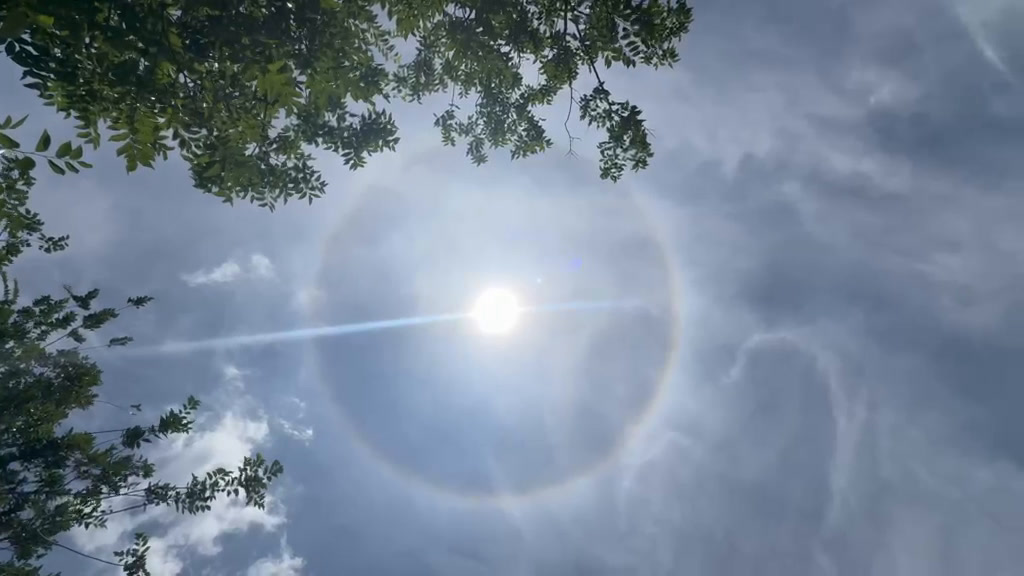
Footage sent to Project CBNews this week shows something that makes people stop on pavements and reach for their phones: the sun, small and hard-white, sitting inside a faint circle of light with a rim that runs from red on the inside to a milky white on the outside. Thin cloud streaks past. Tree branches frame the corner. It lasts a few seconds on screen and, if you have ever stood under one, a good while longer in real life.
The name is dull and the thing is not. Meteorologists call it a 22-degree halo, and it happens when sunlight passes through millions of tiny ice crystals in thin, high cloud. The cloud is cirrus or cirrostratus, and it hangs around 6,000 metres up, the height at which even a Highveld summer is far below freezing. The crystals are hexagonal, which matters, because a six-sided prism bends light by a fixed amount. Almost no light leaves the crystals at less than 22 degrees from the sun. That is why the inside of the ring looks darker and the edge glows, and why the circle is so suspiciously perfect.
There is an easy way to check the number yourself. Hold your arm out and spread your hand wide. Thumb tip to little-finger tip is about 22 degrees. Cover the sun with your thumb, never stare at it, and the ring sits near your pinky.
Yours is not mine
The detail I like most is that a halo belongs to whoever is looking. The light that reaches your eye comes from the crystals at exactly the right angle from where you stand, so the person beside you is seeing a slightly different ring, built from different ice. A rainbow behaves the same way. Nobody else has ever seen quite the thing you just saw.
Not rare, just unnoticed
Halos are not the cosmic event social media makes them out to be. One German halo-observer network rates the 22-degree ring as very frequent, logged on roughly 80 to 120 days a year. The trouble is that most of us do not look up at midday, and the sun is too bright to look at anyway. There are cousins worth knowing: bright patches called sundogs sit on the ring to the left and right of the sun, and a much fainter, wider 46-degree halo shows up now and then.
South Africans have been through this before. On 1 November 2010 the South African Weather Service confirmed a large rainbow-coloured halo over Gauteng, Mpumalanga, Limpopo and the eastern part of North West. Residents of Vryheid and Ballito watched another one cross their skies more recently. Each time, the same two questions follow. What is it? And is it going to rain?
The rain question
The old saying says a ring means rain. The honest answer is: sometimes, loosely, and it depends where you live. The halo cloud does not itself produce rain. It tends to arrive ahead of a low-pressure system, and a low-pressure system often brings rain. So the ring can be an early hint, not a promise. American fact-checkers who looked at the saying landed on the same place: it can be true, and it guarantees nothing. There is a catch the almanacs skip. Much of this weather lore was born in Europe, and such sayings do not hold in every place. Highveld summer weather is built differently, with afternoon storms that often build locally, so I would trust the Weather Service over the sky.
One more thing worth clearing up, because it trips people up. A ring that is small, tight and brightly coloured, hugging the sun or moon, is not a halo. That is a corona, and it comes from water droplets, not ice. A halo is big, faint and wide, about forty-four sun-widths across.
Looking up
The science here is settled and it is lovely: hexagons, six kilometres of cold air, one fixed angle. Explaining it does not shrink it. For many readers the sky has always been the oldest public noticeboard, and Psalm 19 opens by saying the heavens declare the glory of God. You do not need a physics degree to feel that, and you do not need to pretend the ring is a warning to enjoy it. Just look up while it lasts. It will not be the same ring twice.